
Blog · CCTV · Ipswich
Dark evenings: is your CCTV's night vision up to it?
With the clocks gone back, it's dark well before most people get home, and your CCTV now spends more of each day working in the dark than in daylight. Cameras that look sharp at noon can be close to useless at 6pm. Here's how to check yours, what's usually wrong when the night picture is poor, and when an older camera is worth upgrading.
- 25+ yearsin TV and security
- Local engineerswho live where they work
- Local knowledgeof your area’s homes
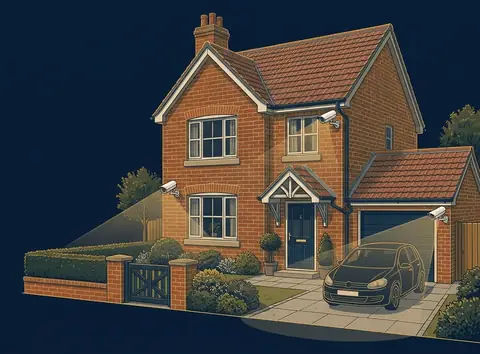
Check your footage after dark
The simplest test is the one most people never do. One evening this week, open the app or go to the recorder and play back an hour of footage from after dark, not the live view. Then ask of each camera:
- Could you recognise someone you know walking up to the front door, or would they just be a grey shape?
- Is the whole view lit, or is there a bright patch near the camera and darkness beyond it?
- Did it actually record, and are the date and time on the footage correct?
- Did motion alerts arrive when someone came to the door, and did you get dozens you didn't need?
Walking out to the drive yourself and then playing it back is a good test. If you can't make out your own face, neither can anyone else.
Infrared and colour night vision: what's the difference?
Most CCTV cameras use infrared. A ring of small LEDs around the lens lights up the scene with light our eyes can't see, and the camera switches to black and white. It works in total darkness, which is why it's so common, but it has limits. You lose all colour, so a red car and a blue car look the same, and the range is set by the LEDs. Beyond that, the picture fades to black.
Colour night vision cameras use a more sensitive sensor and a wider lens opening to keep a colour picture in low light. They need some light to work with, such as a street light, a porch light or a small white light built into the camera. Where there's enough light, the footage is far more useful: you can see the colour of a coat or a car, not just its shape.
Some cameras do both, staying in infrared until they detect a person and then switching on a white light to record in colour. That also tells whoever is on the drive that they've been seen. If you choose a camera with its own light, it needs aiming so it lights your property and not your neighbour's windows. Our guide to home CCTV and the law covers where cameras can look.
Need this done? Call or WhatsApp and a local engineer will give you a straight answer and a price.
Why night footage goes wrong
When a camera that used to work well at night starts giving a poor picture, the cause is usually one of these:
- Spider webs. The infrared light attracts insects in the evening, and spiders follow. A web across the lens glows white at night, blurs the picture and sets off motion alerts every time it moves in the wind. Autumn is the worst time of year for it.
- Dirty or scratched domes. Dome cameras sit behind a clear cover. When it's dusty, misted or scratched, the camera's own infrared reflects off the inside and the whole picture turns to haze.
- Something too close to the view. A soffit, gutter, wall or hanging basket at the edge of the picture bounces infrared straight back. The camera then darkens the whole image to cope, and everything further away disappears.
- Failed infrared LEDs. They wear out, and on older cameras they often fail one at a time. If the night picture has slowly got darker, or a camera that used to show a faint red glow after dark no longer does, this may be why.
- A tired power supply. Infrared LEDs draw extra power. A failing power supply can cope during the day, then cause a flickering picture or a camera that keeps restarting once the LEDs switch on.
Cleaning a dome or brushing away a web is fine if the camera is in easy reach from the ground. Please don't climb a ladder to a camera under the eaves on a dark evening. We'd rather come out and do it safely.
Night vision around Ipswich and Kesgrave
The right answer depends a lot on the street. In Ipswich's older terraced streets, front doors often open almost straight onto the pavement and street lights do much of the work, so a colour camera can give a clear picture of the front without any extra light. The narrow alleys and yards behind those terraces are often much darker, and that's where infrared range matters more. In blocks of flats around the Waterfront and the town centre, communal entrances and car parks usually have lighting of their own, which suits colour cameras well. Our CCTV page for Ipswich covers homes, flats and businesses across the town.
Kesgrave is largely made up of newer estates, where homes are often close together and drives and front gardens face each other. Cameras here need careful aiming so a white light or a wide infrared view doesn't spill into a neighbour's windows. Side gates and back gardens away from the street lights are usually much darker than the front, which is a job for good infrared or a camera with its own light. Our CCTV page for Kesgrave has more on systems for the area.
Repair, adjust or upgrade?
Plenty of night vision problems are fixed without new cameras. Cleaning or replacing a dome cover, moving a camera a little to clear a soffit, replacing a power supply and adjusting the recorder's night settings can transform the footage. We repair systems of any make, including ones fitted by installers who are no longer around.
Upgrading starts to make sense when cameras are old analogue models with low resolution, when the infrared LEDs are failing on several cameras at once, or when you need to identify people rather than just see that someone was there. Modern 4K cameras pick out far more detail at night, and older systems can often be upgraded in stages using the cable that's already in place. If you're adding cameras at the same time, our guide on how many CCTV cameras you need will help you plan.
Whatever we fit or fix, we check every camera after dark as well as in daylight before we hand it over, because that's when it matters most.
Getting it sorted
Our engineers cover Ipswich, Kesgrave, Martlesham, Rushmere and the villages around them. Call or WhatsApp us, Monday to Saturday, 8am to 7pm. A screenshot of the night picture from your app, and the make of the recorder if you know it, helps us work out the likely cause, and you'll get your price on the phone. You can read more about CCTV installation and repair across East Anglia.
Need help locally?
FAQ
Common questions
Free advice, no obligation. Tell us your postcode and what's wrong.
Call 0800 151 2978Why has my CCTV picture gone white or hazy at night?
Usually the camera's own infrared light is bouncing back at it. Common causes are a dirty or scratched dome cover, a spider web across the lens, or a wall, soffit or gutter too close to the edge of the view. Cleaning the cover and adjusting the angle fixes most cases.
Is colour night vision better than infrared?
It shows colours, which helps identify clothing and vehicles, but it needs some light: a street light, a porch light or the camera's own white light. Infrared works in total darkness but gives a black and white picture. Many homes use a mix, and some cameras switch between the two.
Can you upgrade night vision without replacing the whole system?
Often, yes. Newer cameras can usually be added to an existing recorder of the same type, and older analogue systems can be brought up to date in stages, reusing the cable already in the walls. We'll tell you what your recorder can support.
Picture problems or security worries? Talk to an engineer.
Call or WhatsApp for free advice and a price over the phone.