
Guide · Security
Home CCTV and the law
You can put CCTV on your own home. But if a camera captures anything beyond your boundary, such as the pavement, the road or a neighbour's garden, data protection law applies and you take on some responsibilities. Here's what they are, based on guidance from the Information Commissioner's Office.
- 25+ yearsin TV and security
- Local engineerswho live where they work
- Local knowledgeof your area’s homes
When the law applies
If your cameras only record your own property, such as your garden, drive and the inside of your house, data protection law doesn't apply to that use. You can use your system as you like.
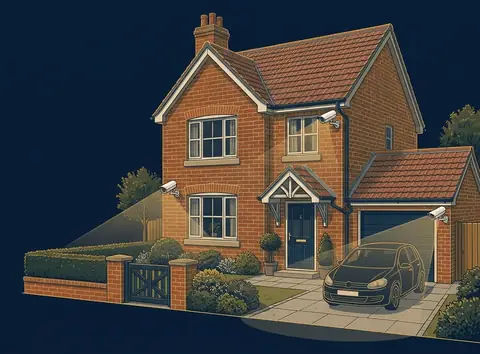
Once a camera captures images of people outside your boundary, things change. Recording the pavement, the street, shared spaces or a neighbour's home or garden brings your use under data protection law. You don't need to stop using the camera, but you do need to follow the rules. This is common: a front-door camera often catches part of the street.
Your responsibilities
The Information Commissioner's Office (ICO) guidance for people using domestic CCTV sets out what you need to do if your cameras capture beyond your boundary.
Have a clear reason
Be clear why you need to record, such as protecting your home from burglary or vehicle crime, and record only what you need for that purpose.
Limit what you record
Position cameras to cover your property and keep beyond-boundary recording to a minimum. Privacy masking blocks out parts of the picture the camera shouldn't record, like a neighbour's windows or garden.
Think about audio
Audio recording is particularly intrusive, and conversations can be picked up from some distance. In most cases it's best to switch it off.
Tell people
Let people know they're being recorded, usually with a clear sign. It's also good practice to talk to your neighbours about it, which avoids most disputes before they start.
Keep footage secure
Protect the recorder and app with strong passwords, keep the firmware up to date and make sure only the people who need to can view the footage.
Don't keep it longer than needed
Set the recorder to overwrite footage regularly. Keep a clip longer only if it's needed, such as evidence of a crime.
Rather talk it through? Call or WhatsApp and a local engineer will give you a straight answer.
Requests from people you've recorded
If your cameras capture beyond your boundary, people you've recorded have rights under data protection law.
- Access: they can ask for a copy of footage of them, and you should normally respond within one month.
- Erasure: they can ask you to delete footage of them, and you should consider it.
- Objection: they can object to being recorded, and you should consider whether you can stop recording them, for example with privacy masking.
When sharing footage, you may need to blur or remove other people in the clip.
Sharing footage with the police and insurers
You can share footage with the police to help investigate a crime, and with your insurer to support a claim. Keep a record of what you shared and why. Posting footage on social media is different: it can identify people who've done nothing wrong, and it's best avoided.
Video doorbells
The same rules apply to video doorbells. Most face the street, so they usually capture beyond your boundary. Check the privacy settings: many let you mask areas, reduce the motion detection zone and switch off audio.
How we help
When we install CCTV, we position cameras to cover your property, set up privacy masking where a view reaches beyond your boundary, switch audio off unless you need it, set a sensible retention period and secure the recorder and app. We can also supply CCTV signs. The result is a system that protects your home without causing problems with the neighbours. See our CCTV installation service, or our guide to how many cameras you need.
This guide is general information based on ICO guidance for domestic CCTV, not legal advice. For the full guidance, see the ICO website.
More guides
Need a hand? See our CCTV service.
FAQ
Common questions
Free advice, no obligation. Tell us your postcode and what's wrong.
Call 0800 151 2978Is it legal to have CCTV on my house?
Yes. Home CCTV is legal. If it only records your own property, data protection law doesn't apply. If it captures public areas or neighbours' property, you need to follow data protection rules.
Can my neighbour make me take my camera down?
The ICO can't make you remove a camera. But if you don't follow data protection law, the ICO can take action, and a neighbour can also take you to court. Respecting privacy from the start avoids disputes.
Do I need a sign for home CCTV?
If your cameras capture images beyond your boundary, you should tell people they're being recorded, and a clear sign is the usual way to do it. Even where it isn't required, a sign is a useful deterrent.
Picture problems or security worries? Talk to an engineer.
Call or WhatsApp for free advice and a price over the phone.