
Guide · Security
How many CCTV cameras do I need?
Most homes are well covered by three to five cameras, but the right number depends on how many ways someone could get in, not on the size of the house. Here's how to plan coverage room by room and side by side.
- 25+ yearsin TV and security
- Local engineerswho live where they work
- Local knowledgeof your area’s homes
Camera planner
How many cameras do you need?
Pick your property and what you'd like to see. We'll show a starting recommendation, then confirm it with you on the phone.
2 cameras
- 4K cameras with colour night vision
- Local recorder, no monthly fee
- Phone app set up before we leave
A starting point only. Your engineer confirms the positions and quotes free on the phone.
Start with the ways in
The best way to plan CCTV isn't to count rooms, it's to count entry points and approaches. Walk round the outside of your home and note every door, every ground-floor window that could be opened, every gate and every route onto the property. Each of those needs to be seen by at least one camera, and ideally from a position where a face is visible rather than the top of a head.
A typical home, side by side
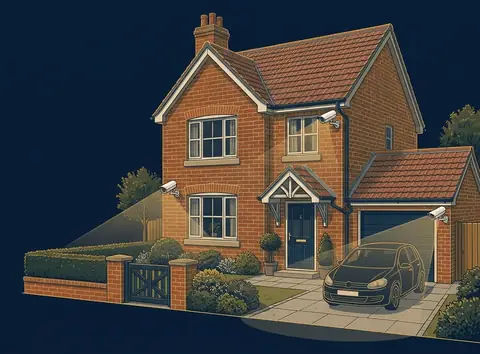
Covering each side of the house gives most semi-detached homes three or four cameras, and most detached homes four to six. Rural properties, farms and homes with long drives or several outbuildings may need more.
Front
One camera covering the front door and the approach, positioned to catch faces at the door. On a larger frontage, a second covering the drive and any cars.
Back
One camera covering the back door, patio doors and garden. Back doors are the most common way in for burglars, because they're out of sight of the street.
Sides
One camera per side passage or gate that gives access to the back. On semi-detached and terraced homes that's often just one; detached homes often need two.
Outbuildings
Garages, sheds and workshops hold bikes, tools and garden machinery, which are popular targets. A camera covering their doors is often worth adding.
Rather talk it through? Call or WhatsApp and a local engineer will give you a straight answer.
Detection, recognition and identification
Not every camera needs to do the same job. It helps to think about what each one is for:
- Detection: showing that someone is there, such as a wide view of the garden or drive.
- Recognition: showing enough to tell whether it's someone you know.
- Identification: enough detail to identify a stranger, which needs a closer, tighter view, usually at a door or gate.
A good system mixes wide views for detection with tighter views at the points people must pass through. A wide-angle camera on the corner of a house sees a lot but captures little detail at distance; a camera aimed at a doorway from a few metres away captures a clear face.
Lens, resolution and night vision
Wider lenses cover more ground but show less detail. Varifocal cameras let us adjust the view on site, so each camera covers exactly what it needs to. Resolution of 4MP to 8MP gives clear recordings for most homes. Night performance matters just as much: colour night vision with a small amount of white light, or good infrared, keeps footage useful after dark, when most incidents happen.
Where the cameras shouldn't point
Cameras should cover your own property. If one has to see beyond your boundary, such as part of the street or a neighbour's garden, data protection law applies. Privacy masking blocks out areas the camera shouldn't record. See our guide to home CCTV and the law.
The recorder and storage
A recorder with more channels than you need now makes it easy to add cameras later. Storage depends on the number of cameras, resolution and how long you want to keep footage. Most homes keep two to four weeks, which is plenty to review an incident.
How we plan your system
We walk round your property with you, look at every approach, and suggest a camera position and lens for each one, explaining what it will see. You get a clear plan and a price quoted on the phone or on site, with no cameras added just to pad out a kit. Try the planner above, or see our CCTV installation service.
More guides
Need a hand? See our CCTV service.
FAQ
Common questions
Free advice, no obligation. Tell us your postcode and what's wrong.
Call 0800 151 2978Is one camera enough for a house?
One camera on the front door is better than none, and a video doorbell does that job well. But most break-ins at houses happen through the back or side, so one camera rarely covers the real risks.
Do more megapixels mean I need fewer cameras?
Not really. Higher resolution lets you zoom into a recording, but a camera can only see what's in front of it. Coverage comes from position and lens angle, and resolution decides how much detail you get at a distance.
Can I add cameras later?
Yes. If the recorder has spare channels, adding a camera is straightforward. We usually suggest a recorder with a few spare channels for exactly that reason.
Picture problems or security worries? Talk to an engineer.
Call or WhatsApp for free advice and a price over the phone.