
Guide · Home
Satellite dishes and planning rules
Most homes in England can have a satellite dish without planning permission, as long as it meets a few size and position rules. Conservation areas, the Norfolk and Suffolk Broads and listed buildings have extra restrictions. Here's what they mean in practice.
- 25+ yearsin TV and security
- Local engineerswho live where they work
- Local knowledgeof your area’s homes
Where should your dish point?
Sky and Freesat come from the Astra satellites at 28.2° east, so every dish in East Anglia looks south-east. The exact angle changes from town to town.
- Direction
- –
- Tilt up
- –
- LNB twist
- –
A few degrees out and the picture drops in heavy rain. We align every dish with a meter, then lock it off.
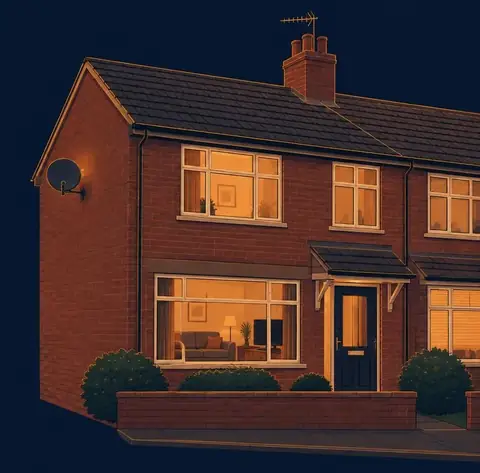
Satellite in IpswichThe basic rules for houses
In England, satellite dishes and other antennas are covered by "permitted development" rights, which let you fit them without applying for planning permission as long as you stay within certain limits. For a house under 15 metres high that isn't in a designated area, the Planning Portal sets out these conditions:
- No more than two antennas on the property in total.
- One antenna: no more than 100 cm in any linear dimension.
- Two antennas: one no more than 100 cm, the other no more than 60 cm.
- Volume: each no more than 35 litres.
- On a chimney: no more than 60 cm in any linear dimension.
- Above the roof: only where there's a chimney stack, and by no more than 60 cm above the highest part of the roof or the chimney, whichever is lower.
The size limits exclude the feed arm, reinforcing rim, mounting and brackets. A standard Sky or Freesat dish is well within them.
Conservation areas and the Broads
Many of the towns we cover have conservation areas, including the historic centres of Bury St Edmunds, Sudbury, Saffron Walden, Ely, Wisbech, King's Lynn and Norwich. In these designated areas, the same size limits apply, plus one more: the dish must not be fitted on a chimney, wall or roof slope that faces onto, and is visible from, a road. The same restriction applies to walls and roof slopes facing a Broads waterway, which matters for homes along the rivers of the Norfolk and Suffolk Broads.
In practice this usually means a side or rear wall, an outbuilding, or a low position in the garden. From East Anglia the satellites sit to the south-east, so if the back of your house faces roughly that way, a compliant position is usually easy to find.
Designated areas also include National Parks, Areas of Outstanding Natural Beauty such as the Suffolk Coast and Heaths and the Norfolk Coast, and World Heritage Sites.
Rather talk it through? Call or WhatsApp and a local engineer will give you a straight answer.
Listed buildings
Listed buildings are a separate matter. Listed building consent is generally needed for any antenna that affects the character or appearance of the building or its setting, even if planning permission isn't. On listed homes, we look first at options that don't touch the building: a dish in the garden, on an outbuilding, or Freeview through a loft aerial. Your council's planning department can tell you whether a building is listed.
Flats and taller buildings
For flats, the limits apply to the building as a whole, not to each flat. If the building already has the maximum number of dishes, any more need planning permission. Buildings 15 metres or taller have their own, slightly different rules. In practice, a shared satellite system feeding every flat from one or two dishes is often the neatest answer, and we install and repair these for landlords and managing agents.
New homes and converted buildings
Permitted development rights for antennas don't apply to houses created under certain change-of-use rights or new-dwelling rights, so some converted buildings need planning permission for a dish. Separately, many new estates have covenants in the deeds restricting where a dish can go, often to the side or rear. Covenants are a private matter between you and the developer or management company, separate from planning, so it's worth checking your deeds before booking.
Rented homes
If you rent, your tenancy may require the landlord's permission for a dish, whatever the planning position. Once you have it, we fit to their requirements.
How we handle it
On every job we look at where the dish can go, explain any planning or covenant issues we're aware of, and find a position with a clear view to the satellites that keeps you within the rules. If we think permission or consent might be needed, we'll say so before we fit anything. When in doubt, your local planning authority can give a definitive answer. This guide covers England; rules in Wales and Scotland differ.
More guides
Need a hand? See our satellite service.
FAQ
Common questions
Free advice, no obligation. Tell us your postcode and what's wrong.
Call 0800 151 2978Do I need planning permission for a satellite dish?
Usually not, if your house is under 15 metres high, you have no more than two antennas, and the dish meets the size limits. Conservation areas, the Broads and listed buildings have extra rules.
Can I put a dish on the front of my house in a conservation area?
Not without planning permission if that wall or roof slope faces onto, and is visible from, a road. A side or rear position is usually the answer.
Can I fit a dish to my flat?
The limits apply to the building as a whole, and your lease or tenancy may also restrict dishes. Many blocks have a shared system you can connect to instead.
Picture problems or security worries? Talk to an engineer.
Call or WhatsApp for free advice and a price over the phone.