
Blog · TV aerials · Lowestoft
Storm-damaged TV aerial? What to check first on the coast
When the first autumn gales come in off the North Sea, aerials along the coast take the brunt. If your Freeview picture has broken up or vanished after a windy night, here's what you can safely check from the ground, what has probably happened on the roof, and when it's time to call an engineer.
- 25+ yearsin TV and security
- Local engineerswho live where they work
- Local knowledgeof your area’s homes
Stay off the roof
However tempting it is on a calm morning after the storm, please don't climb up to have a look. Roofs, chimney stacks and gutters are often damaged in the same gale that moved the aerial, and wet tiles are treacherous. Everything in this post can be checked from the ground or indoors.
If the aerial, its pole or a chimney bracket is hanging loose and could fall onto a path, a car or a neighbour's property, keep people away from underneath it and tell us when you call. Making it safe comes before getting the picture back.
Signs the storm has got to your aerial
A damaged aerial rarely fails all at once. These are the usual signs after a windy night:
- The picture breaks up when the wind blows and settles when it drops. The aerial or its clamp has worked loose and is moving.
- Some Freeview channels have disappeared while others are fine. The aerial has been knocked slightly off line, so the weaker channels drop out first.
- No signal on every TV in the house. The aerial, the cable or a masthead amplifier has failed.
- You can see the damage: the aerial twisted round, elements bent, the pole leaning, or a cable flapping against the wall.
If only one TV is affected and the others are fine, the problem is almost certainly indoors: a loose plug in the wall socket, a damaged fly lead, or the TV itself. Our guide to why a TV picture pixelates covers those.
Need this done? Call or WhatsApp and a local engineer will give you a straight answer and a price.
Quick checks you can do safely
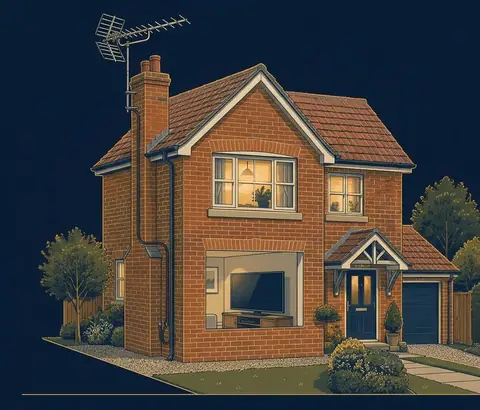
From the garden or across the road, have a look at the aerial and compare it with your neighbours'. Aerials in the same street usually point the same way, so one facing a different direction stands out. A photo on your phone, zoomed in, often shows a bent element or a slipped clamp clearly.
Indoors, check every TV, and push the aerial plugs firmly into the wall sockets and the TVs. If you have an amplifier in the loft or by the TV, check its power light is on and the plug hasn't been switched off.
A retune is worth trying only if all the TVs show the same missing channels and the aerial looks straight. If the storm has moved the aerial, a retune just stores fewer channels, so don't keep retuning in the hope it'll come back.
Why aerials on the coast take a beating
Homes along the seafront in Lowestoft and in Great Yarmouth and Gorleston have nothing between them and the North Sea, so they catch the full force of an easterly gale. Salt air makes it worse. It corrodes cheap steel clamps and brackets from the inside, so a fitting that looks fine can snap in the next strong wind.
The signal side matters too. Many homes here point at Tacolneston, south-west of Norwich, while others use a nearby relay: Lowestoft's own relay, or the Gorleston-on-Sea relay around Yarmouth. Relays carry a smaller set of channels than the main transmitter, and the two need the aerial pointing in different directions. After a storm we check which one your aerial should be aimed at, rather than just pushing it back to where it was. Our guide to which TV transmitter serves your area explains the difference.
Repair or replace?
Most storm calls are repairs: re-securing a slipped clamp, fitting a new chimney bracket or pole, replacing a short length of damaged cable, and realigning the aerial with a signal meter. We test the signal at the aerial and at every TV point before we leave.
Sometimes a new aerial is the better answer. If the old one is badly bent, heavily corroded, or an older design that doesn't cover every frequency Freeview uses today, replacing it costs little more than repairing it, and a wideband aerial on stainless or heavy-duty fixings will stand up to the next winter far better. We'll tell you which makes sense and why.
Getting it fixed
Our engineers cover Lowestoft, Great Yarmouth, Gorleston, Beccles and the villages around them, and know which streets point where. Call or WhatsApp us, Monday to Saturday, 8am to 7pm. A photo of the aerial taken from the ground helps us bring the right parts, and you'll get your price on the phone before we book you in.
FAQ
Common questions
Free advice, no obligation. Tell us your postcode and what's wrong.
Call 0800 151 2978Will a retune fix my TV after a storm?
Only if the aerial is still pointing the right way and the problem is with the TV's channel list. If the storm has moved, bent or loosened the aerial, a retune usually finds fewer channels, not more. Check your other TVs first: if they're all affected, the problem is outside.
Is a storm-damaged aerial covered by home insurance?
Some buildings policies cover storm damage to aerials and satellite dishes, and some exclude them, so check your policy wording. Take photos from the ground before anything is repaired, and keep the invoice. We describe the damage we find and what we replaced on the invoice.
Is it safe to leave a loose aerial until it's fixed?
If it's only slightly out of line, yes. If the aerial or pole is hanging off the chimney, swinging, or could fall onto a path, a driveway or a neighbour's roof, keep people clear underneath and call us so it can be made safe first.
Picture problems or security worries? Talk to an engineer.
Call or WhatsApp for free advice and a price over the phone.